
page
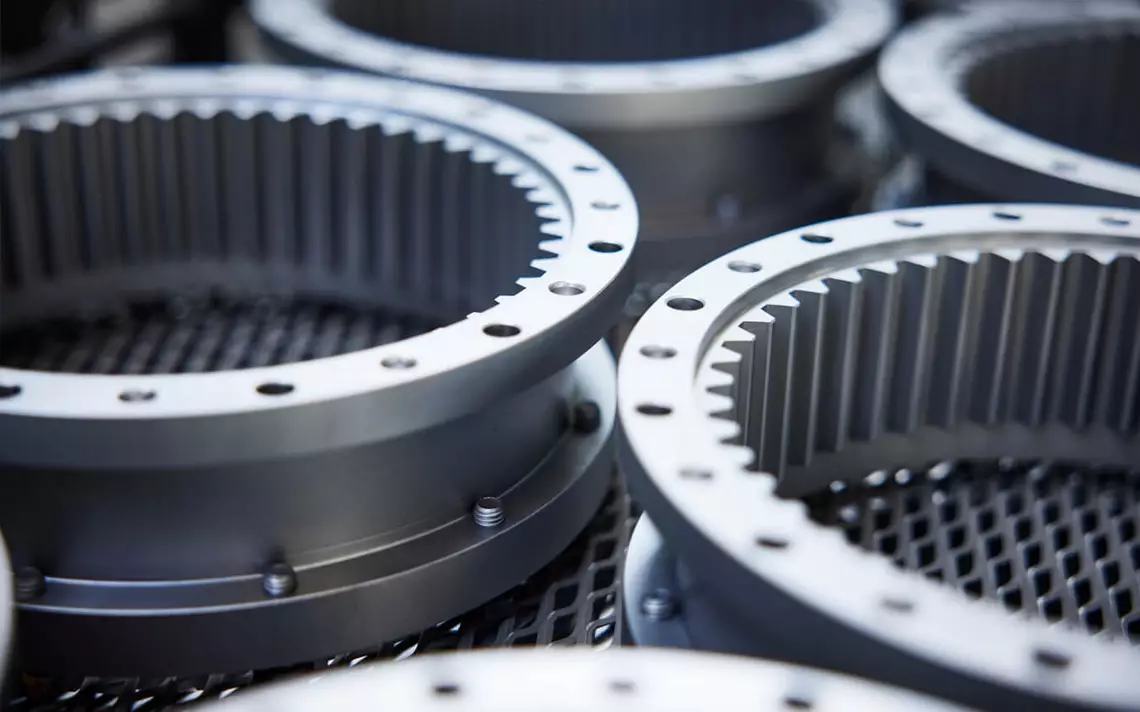
Procédé de nitruration et de nitrocarburation
La nitruration est un traitement thermochimique dans lequel l'azote se diffuse à la surface de l'acier pour augmenter sa dureté, sa résistance à l'usure et sa résistance à la fatigue.
La nitrocarburation est un procédé apparenté qui consiste à introduire à la fois de l'azote et du carbone à la surface par ajout de propane ou de méthane
La profondeur du traitement de nitruration dépend du temps et de la température, et le procédé est réalisé sous atmosphère contrôlée. Certains aciers nitrurés permettent la formation de nitrures durs (ε, γ’).
Le procédé de nitruration produit généralement une structure à deux couches : une couche composée et une couche de diffusion, dont la formation dépend du potentiel de nitruration.
La nitrocarburation réduit le temps de cycle et permet un meilleur contrôle de la composition de la couche.
La température des procédés de nitruration se situe généralement entre entre 490 °C et 560 °C, en fonction du matériau et des caractéristiques de couche souhaitées.
page
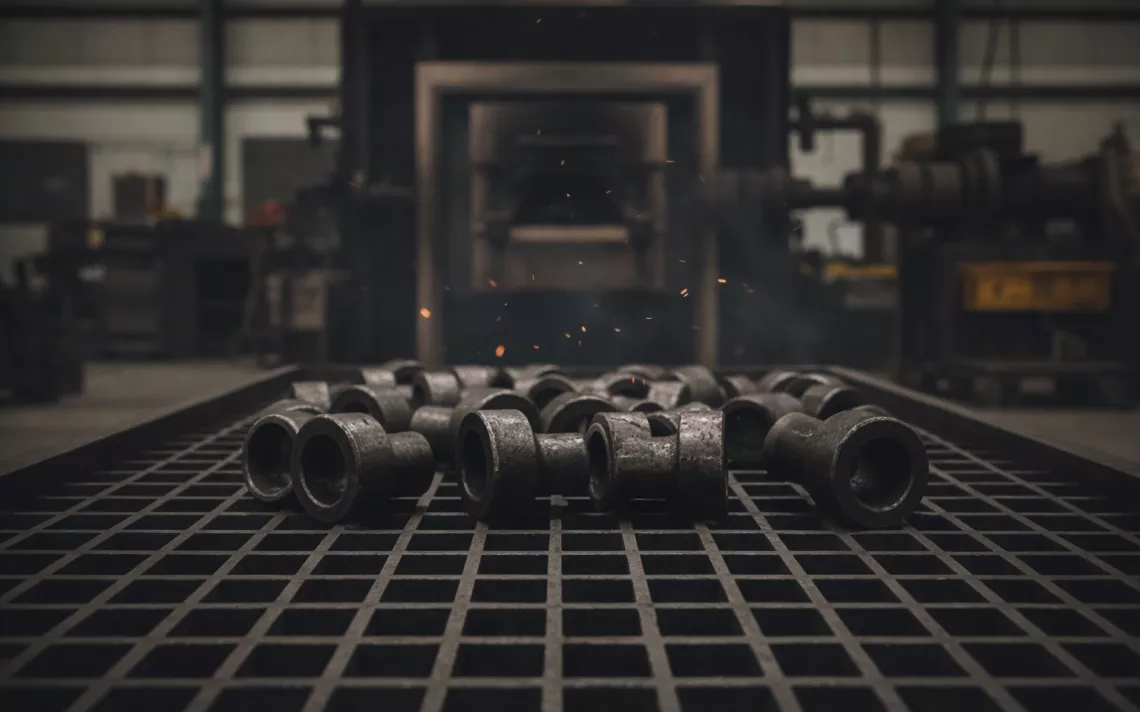
Wärmebehandlungsprozess zum Anlassen
Das Anlassen erfolgt nach dem Härten, um Härte und Zähigkeit in Stahlbauteilen auszugleichen.
Da gehärtete Teile sehr hart, aber spröde sind, verringert das Anlassen die Härte, erhöht die Duktilität und stabilisiert die mechanischen Eigenschaften. Die Temperaturkontrolle während des Anlassens ist entscheidend, um die gewünschte Endleistung zu erzielen.
Die erforderliche Anlasstemperatur hängt von der Stahlsorte und der Zielhärte ab. Nach dem Anlassen entsteht eine Mikrostruktur aus angelassenem Martensit, die eine stabile Kombination aus Festigkeit und Zähigkeit bietet.
Je nach Legierungselementen können bestimmte Stähle – wie z. B. Maraging-Stähle – während des Anlassens sogar an Härte gewinnen.
page
Tempering heat treatment process
Tempering is performed after hardening to balance hardness and toughness in steel components.
Because hardened parts are highly hard but brittle, tempering reduces hardness, increases ductility and stabilizes mechanical properties. Temperature control during tempering is essential to achieve the desired final performance.
The required tempering temperature depends on the steel grade and the target hardness. After tempering, the microstructure becomes tempered martensite, offering the desired compromise between mechanical strength and hardness.
Depending on alloying elements, certain steels—such as maraging steels—can even gain hardness during tempering.
page
Procédé de revenu
Le revenu est effectué après la trempe afin d'équilibrer la dureté et la ténacité des composants en acier..
Les pièces trempées étant très dures mais fragiles, le revenu permet de réduire leur dureté, d'accroître leur ductilité et de stabiliser leurs propriétés mécaniques. La maîtrise de la température lors du revenu est essentielle pour obtenir les performances finales souhaitées.
La température de revenu requise dépend de la nuance d'acier et de la dureté cible. Après revenu, la microstructure devient martensite revenue, offrant le compromis souhaité entre résistance mécanique et dureté.
Selon les éléments d'alliage, certains aciers, comme les aciers maraging, peuvent même gagner en dureté lors du revenu.

page
Lötverfahren für Metallverbindungen
Löten ist ein Metallverbindungsverfahren, bei dem Bauteile unter Verwendung eines Füllmetalls zusammengefügt werden, dessen Schmelzpunkt unter dem der Grundwerkstoffe liegt.
Im Gegensatz zum Schweißen schmilzt das Grundmetall nicht: Nur die Fülllegierung verflüssigt sich und fließt durch Kapillarwirkung in die Verbindung, wodurch eine starke, dichte und dauerhafte Verbindung entsteht. Löten eignet sich ideal für Präzisionsbaugruppen, die mechanische Festigkeit und minimale Verformung erfordern.
Die Löttemperaturen liegen typischerweise zwischen 180 °C und 1200 °C, wobei die gängigsten industriellen Anwendungen zwischen 450 °C und 1100 °C liegen. Je nach Zusatzwerkstoff und Materialanforderungen kann der Prozess unter folgenden Bedingungen durchgeführt werden:
- Neutrale Atmosphären (N₂, Ar)
- Reduzierenden Atmosphären (H₂)
- Kontrollierten Mehrgas-Schutzatmosphären
Diese kontrollierten Bedingungen verhindern Oxidation und gewährleisten saubere, hochwertige Verbindungen.
page
Brazing process for metal joining
Brazing is a metal-joining process in which components are assembled using a filler metal whose melting point is lower than that of the base materials.
Unlike welding, the base metal does not melt: only the filler alloy liquefies and flows by capillarity into the joint, creating a strong, sealed and durable bond. Brazing is ideal for precision assemblies requiring mechanical strength and minimal distortion.
Brazing temperatures typically range from 180 °C to 1200 °C, with the most common industrial applications between 450 °C and 1100 °C. Depending on the filler metal and material requirements, the process can be carried out under:
- Neutral atmospheres (N₂, Ar)
- Reducing atmospheres (H₂)
- Controlled multi-gas protective atmospheres
These controlled conditions prevent oxidation and ensure clean, high-quality joints.
page
Procédé de brasage pour l'assemblage des métaux
Le brasage est un procédé d'assemblage de métaux dans lequel les composants sont assemblés à l'aide d'un métal d'apport dont le point de fusion est inférieur à celui des matériaux de base.
Contrairement au soudage, le métal de base ne fond pas : seul l’alliage d’apport se liquéfie et s’écoule par capillarité dans le joint, créant ainsi une liaison solide, étanche et durable. Le brasage est idéal pour les assemblages de précision exigeant une grande résistance mécanique et une déformation minimale.
Les températures de brasage varient généralement de 180 °C à 1200 °C, les applications industrielles les plus courantes se situant entre 450 °C et 1100 °C. Selon le métal d'apport et les exigences relatives aux matériaux, le procédé peut être réalisé dans les conditions suivantes :
- Atmosphères neutres (N₂, Ar)
- Atmosphères réductrices (H₂)
- Atmosphères protectrices multigaz contrôlées
Ces conditions contrôlées empêchent l'oxydation et garantissent des joints propres et de haute qualité.
page
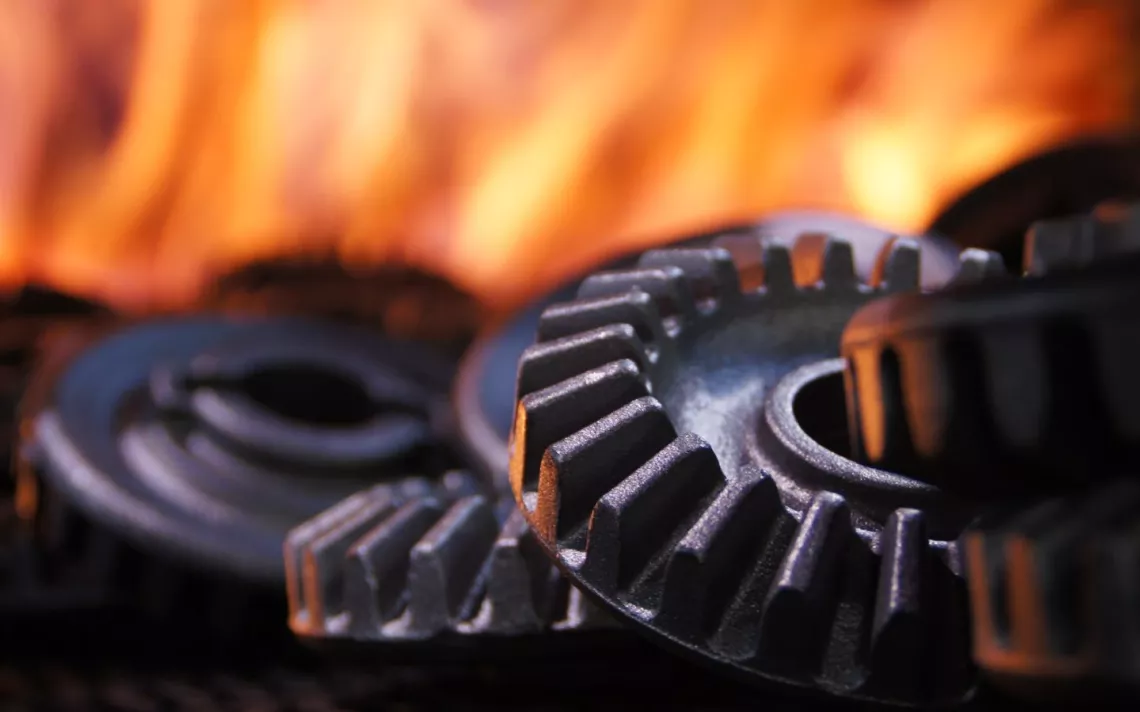
Normalisierungswärmebehandlung
Normalisieren ist eine Wärmebehandlung, die zur Verfeinerung der Mikrostrukturen von Stahl und zur Wiederherstellung ihres mechanischen Gleichgewichts eingesetzt wird.
Der Prozess besteht darin, das Material über die kritische Temperatur AC3 zu erhitzen und anschließend in ruhender Luft abzukühlen. Durch diese Umwandlung wird Austenit in eine feine ferritisch-perlitische Struktur mit verbesserten mechanischen Eigenschaften umgewandelt.
Das Normalisieren verbessert die Kornstruktur, erhöht die Homogenität und baut innere Spannungen ab, die beim Umformen, Bearbeiten oder Schmieden entstanden sind.
Typische Normalisierungstemperaturen liegen etwa 50 °C über AC3, anschließend erfolgt eine kontrollierte Luftkühlung, um ein gleichmäßiges Mikrogefüge zu erzielen.
page
Normalizing heat treatment process
Normalizing is a heat treatment used to refine steel microstructures and restore their mechanical balance.
The process consists of heating the material above the AC3 critical temperature, followed by cooling in still air. This transformation converts austenite into a fine ferrito-pearlitic structure with improved mechanical properties.
Normalizing improves grain structure, enhances homogeneity and relieves internal stresses introduced during forming, machining or forging.
Typical normalizing temperatures are approximately 50 °C above AC3, followed by controlled air cooling to achieve a uniform microstructure.
page
Procédé de normalisation
La normalisation est un traitement thermique utilisé pour affiner les microstructures de l'acier et rétablir son équilibre mécanique.
Le procédé consiste à chauffer le matériau au-dessus de la température critique AC3, puis à le refroidir à l'air ambiant. Cette transformation convertit l'austénite en une structure ferrito-perlitique fine aux propriétés mécaniques améliorées.
La normalisation améliore la structure granulaire, accroît l'homogénéité et atténue les contraintes internes introduites lors du formage, de l'usinage ou du forgeage.
Les températures de normalisation typiques sont d’environ 50 °C au-dessus d’AC3, suivi d'un refroidissement à air contrôlé pour obtenir une microstructure uniforme.
page
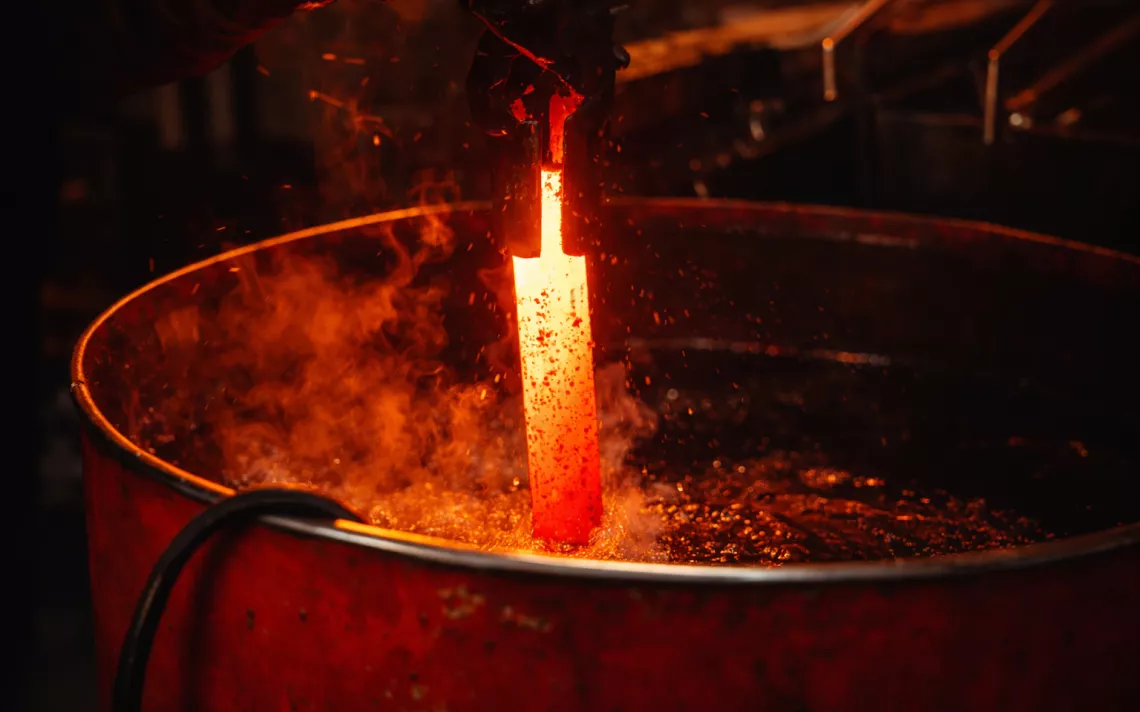
Abschreckprozess
Das Abschrecken ist der letzte und entscheidende Schritt des Härtungsprozesses.
Nach dem Erhitzen über die kritische Temperatur AC3 werden die Teile schnell unter die martensitische Endtemperatur (Ms) abgekühlt. Diese Umwandlung von Austenit in Martensit führt zu einer deutlichen Erhöhung der Härte und der mechanischen Festigkeit.
Das Abschrecken kann in verschiedenen Medien erfolgen – Gasen, Salzen, Ölen, Wasser oder Luft –, die jeweils eine bestimmte Abkühlungsgeschwindigkeit und einen bestimmten Betriebsbereich bieten. Die Auswahl des richtigen Abschreckmediums ist entscheidend, um eine vollständig martensitische Struktur zu erhalten und gleichzeitig unerwünschte Mischphasen wie Perlit oder Bainit zu vermeiden.
page
Quenching heat treatment process
Quenching is the final and critical step of the hardening process.
After heating above the AC3 critical temperature, parts are rapidly cooled below the martensitic finish temperature (Ms). This transformation of austenite into martensite leads to a significant increase in hardness and mechanical strength.
Quenching can be performed in various media—gas, salt, oil, water or air—each offering a specific cooling rate and operating window. Selecting the right quenching medium is essential to obtain a fully martensitic structure while avoiding undesirable mixed phases such as pearlite or bainite.